An open pearl ring can offer some flexibility in fit, but “adjustable” should not be read as “fits every finger” or as permission to bend the ring repeatedly. A sensible approach is to compare the ring’s design with the finger you plan to wear it on, make only a small correction if needed, and stop as soon as the metal resists. If it does not sit comfortably after a conservative adjustment, a jeweler can assess whether further work is appropriate.
Pearls also call for care that differs from many hard gemstones. The pearl and the ring’s metal setting have different needs, so avoid assuming that a cleaning method or adjustment that suits one part is suitable for the whole piece. Understanding the ring’s opening, checking the fit before wearing it out, and using gentle cleaning habits can help you make a more informed choice. The same principles do not automatically apply to an adjustable bangle, which is worn around the wrist and has a different fit to assess.
What “adjustable” means for an open ring
An open ring has a gap in the band, allowing some change in its opening. That construction may accommodate a modest fit correction, but it does not establish a universal size range. Finger shape, the width of the band, and the position of a prominent pearl all affect how a ring feels and sits. The useful question is not simply whether the opening can move; it is whether the ring can be made comfortable without force and remain positioned as intended.
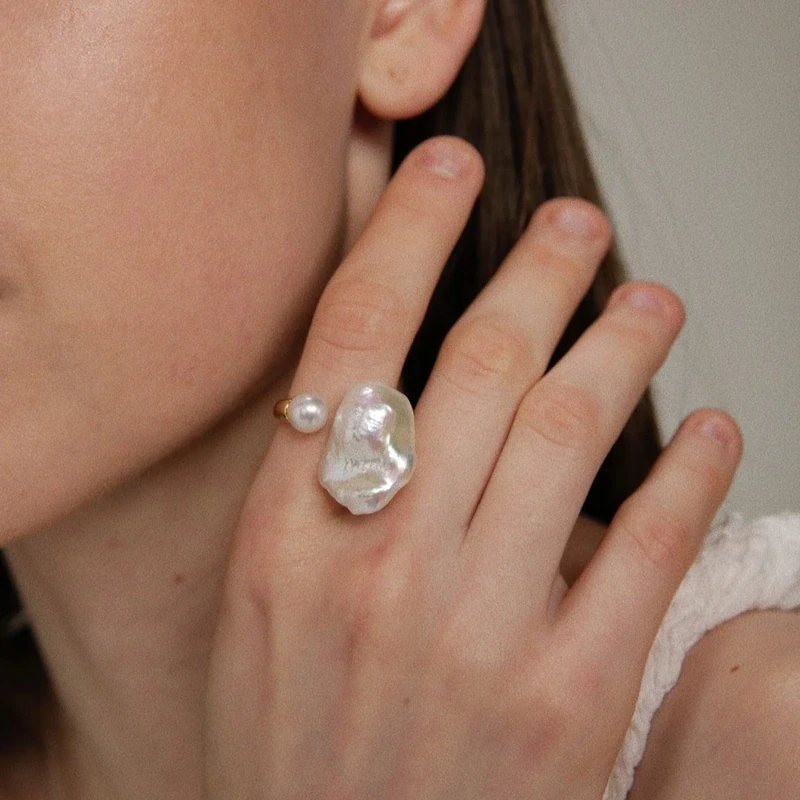
The Oversized Baroque Pearl Open Ring is described as an open, adjustable ring made with a baroque pearl and S925 sterling silver plated with 18K gold. Its description does not give a numeric size range, so do not assume a particular set of finger sizes will fit. Baroque describes an irregular pearl shape; it does not establish the pearl’s origin. For additional styles, browse the pearl and jewelry ring collection, then review each item’s listed materials and fit details individually.
Check the intended finger before adjusting
Try to identify the finger and hand where you expect to wear the ring before making any change. Fingers can differ in size, and fit can feel different at the base of a finger than over the knuckle. A ring that is too loose may rotate or shift; one that is too tight may be difficult to remove. Consider the pearl’s position as well: a large, irregular pearl can make a ring feel visually or physically more prominent, so the most comfortable finger may not be the one you first expect.
Test the ring gently on a clean, dry hand, moving it over the knuckle without forcing it. It should not pinch, feel unstable, or require strain to put on or remove. If the fit is uncertain, avoid trying to solve the problem through larger changes to the opening. Instead, pause and seek advice from a qualified jeweler, especially when the pearl or setting appears to shift. For comparison while shopping, use a ring you already find comfortable as a guide, but do not treat its size as a guarantee that a different design will fit identically.
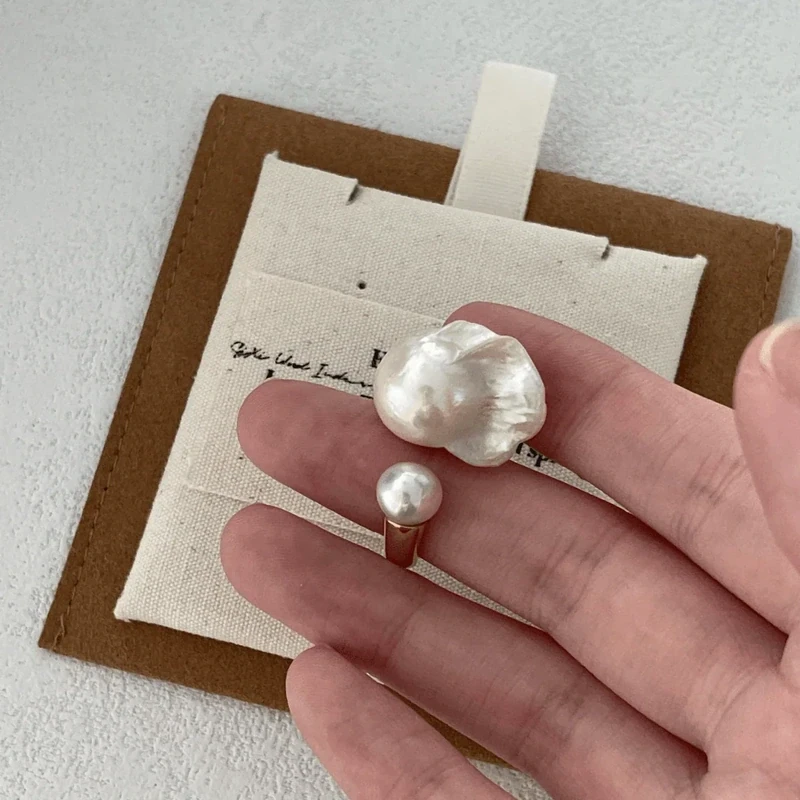
Make only a conservative fit correction
If the open design needs a slight adjustment, work slowly and use only a small movement. Avoid pulling the two ends far apart or squeezing them sharply together. Repeated bending can stress jewelry, and putting force near the pearl may transmit strain to the setting. This is a precaution, not a claim about how a particular ring was made or how its pearl is attached. Do not grip the pearl to control the ring, and do not use tools unless a professional has advised you on the specific piece.
Stop immediately if you feel resistance, hear an unusual sound, notice a visible change, or see the pearl or setting move. Do not keep bending in an effort to reach a particular size; the word “adjustable” is not a promise of unlimited sizing. Have a jeweler inspect the ring if it does not fit after a modest correction, or if you are unsure how the band responds. A professional can judge the piece directly rather than relying on a general rule that may not suit its materials or condition.
Do not confuse rings with adjustable bangles
Both an open ring and an adjustable bangle may have an opening, but they serve different parts of the body and require different fit checks. A ring needs to pass over a knuckle and stay securely on a finger. A bangle must be considered in relation to the wrist and the way it goes on and sits there. The amount of adjustment, the fit range, and the suitable handling for one type should not be inferred from the other.
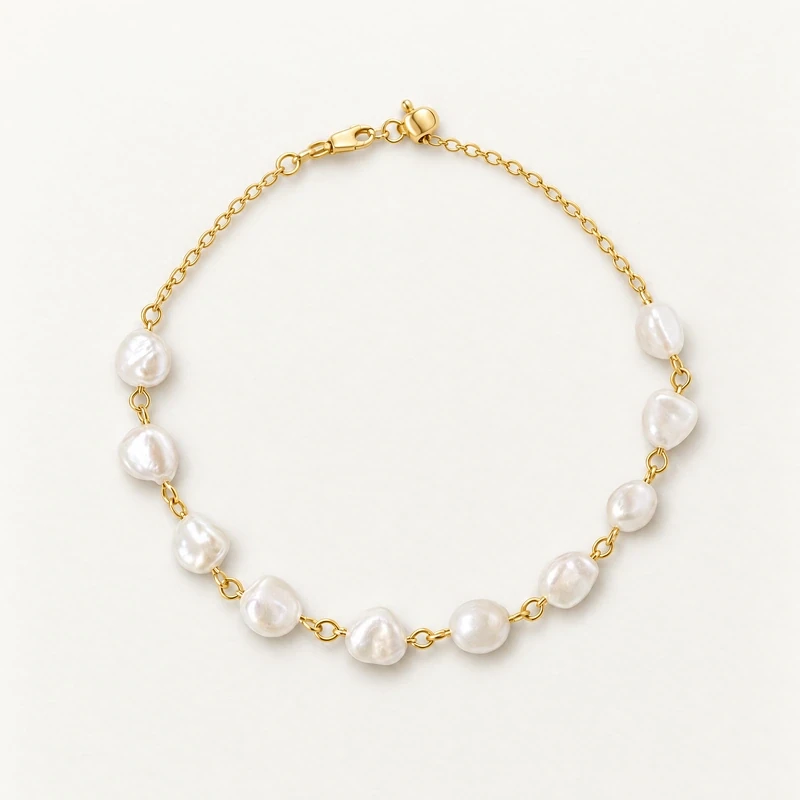
For example, the ALANA Purple Baroque Pearl Bangle is listed with an adjustable diameter of approximately 6–7.6 cm (2.5–3 in) and a 25–35 mm pearl. Those are bangle measurements, not a sizing reference for an open ring. The IDA Bracelet with Baroque Pearls is described as approximately 5.5 cm in diameter and 17 cm in perimeter, adjustable, with pearls measuring approximately 15–25 mm. Check the measurements for the specific bracelet and your wrist rather than transferring ring-fitting advice to it.
Understand the pearl and metal materials
Material wording matters when choosing how to wear and care for a piece. The Oversized Baroque Pearl Open Ring lists a baroque pearl and S925 sterling silver plated with 18K gold. Sterling silver 925 means 92.5 percent silver; gold-plated silver is not the same material description as solid gold, gold-filled jewelry, or vermeil. Vermeil has a sterling silver base, but the ring’s listed wording is gold-plated silver, so it should not be relabeled as vermeil.
Do not assume a plated finish is waterproof, tarnish-free, or suitable for every wearer. No such property follows from the material description alone. Pearl care also informs the choice of cleaning and storage: GIA describes pearls as soft, at Mohs 2.5, and advises avoiding ultrasonic and steam cleaners, acids, chemicals, perfume, and excessive heat. For a mixed-material ring, take the conservative approach that protects the pearl as well as the metal. Read the GIA guidance on pearl care and cleaning and the FTC guide to gold and silver jewelry terms for further context.
Clean gently and keep products away
After wearing the ring, wipe the pearl with a soft, clean cloth. This simple step removes surface residue without relying on a harsh cleaner. Keep perfume, cosmetics, household chemicals, and acidic substances away from the pearl, and avoid exposing it to excessive heat. Do not use an ultrasonic or steam cleaner. A cleaning method recommended for a metal component alone may be unsuitable for the pearl, so treat the complete ring as mixed-material jewelry.
GIA notes that occasional cleaning with warm soapy water may be possible for pearls, but a ring should be handled conservatively because its exact setting and condition matter. If you choose this method, avoid soaking or scrubbing aggressively, and dry the piece carefully with a soft cloth. If the pearl appears loose, or if you are uncertain whether water could affect the setting, ask a jeweler before cleaning. More detailed general advice is available in the jewelry care guide; for a particular ring, its materials and condition should guide the final decision.
Store and wear the ring with care
Store the ring where it will not be rubbed or knocked against harder jewelry. A separate soft pouch or compartment can reduce contact with other pieces. Avoid leaving it in a hot place or where it may encounter household products. Before putting it away, make sure it is clean and dry. If you notice a change in the pearl, band, or setting, set the ring aside rather than continuing to wear it until the piece has been checked.
When wearing it, consider activities that may expose the ring to impact, pressure, chemicals, or heat. Removing it before those activities is a practical precaution for a pearl-centered design, not a claim that the ring is fragile under ordinary wear. Do not use the ring as a handle or press against the pearl when putting it on or taking it off. If the opening has shifted or the ring begins to rotate unexpectedly, avoid repeatedly reshaping it at home. Arrange a professional assessment instead.
Use a simple fit-and-care routine
Before purchase or first wear, confirm that the design is an open ring and check any listed measurements rather than assuming “adjustable” means unrestricted sizing. Try it on gently, assess both the knuckle and the resting position, and make at most a small correction if the ring responds without resistance. Stop if it resists, moves unexpectedly, or seems to place strain near the pearl. A jeweler is the safer next step when fit requires more than a conservative adjustment.
After wearing, wipe the pearl with a soft clean cloth, keep it away from chemicals and excessive heat, and store it separately from pieces that could scratch or knock against it. Use neither steam nor ultrasonic cleaning. Keep ring-specific advice separate from bangle measurements and wrist fit, and distinguish gold plating from other metal categories when evaluating materials. This sequence—check, adjust gently, stop when uncertain, and clean conservatively—offers a practical way to enjoy an adjustable pearl ring while respecting both its fit and its materials.