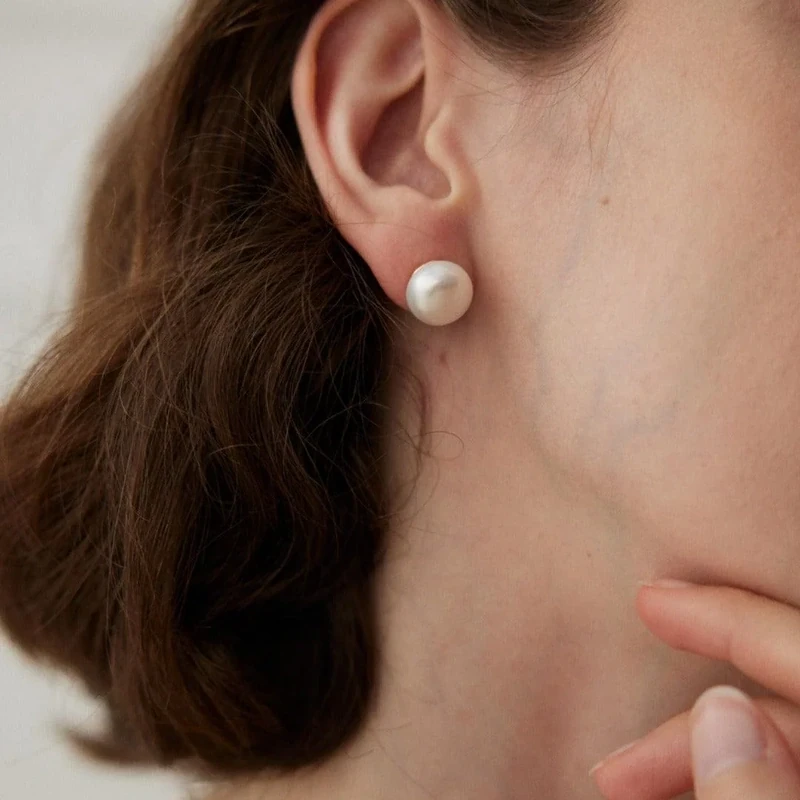
Pearl stud earrings can look very different even when their measurements seem close. A round or oval pearl sitting near the ear presents a compact profile, while a pearl attached beneath a stud extends farther down the lobe. Shape matters, too: a teardrop or irregular baroque pearl occupies space differently from a round pearl of the same approximate width. To compare styles accurately, look for both the pearl measurement and the stated overall earring dimensions.
Those figures answer different questions. Pearl diameter describes the pearl itself, while total earring length can include a stud, connector, or hanging pearl. A product described as a stud may therefore have a short drop rather than a pearl that sits flush against the lobe. Before choosing, consider where you want the visual emphasis, how much length you prefer, and whether the listed measurement refers to the pearl or the whole earring. This approach makes comparisons more useful than relying on labels such as “small” or “medium.”
Read the measurement labels carefully
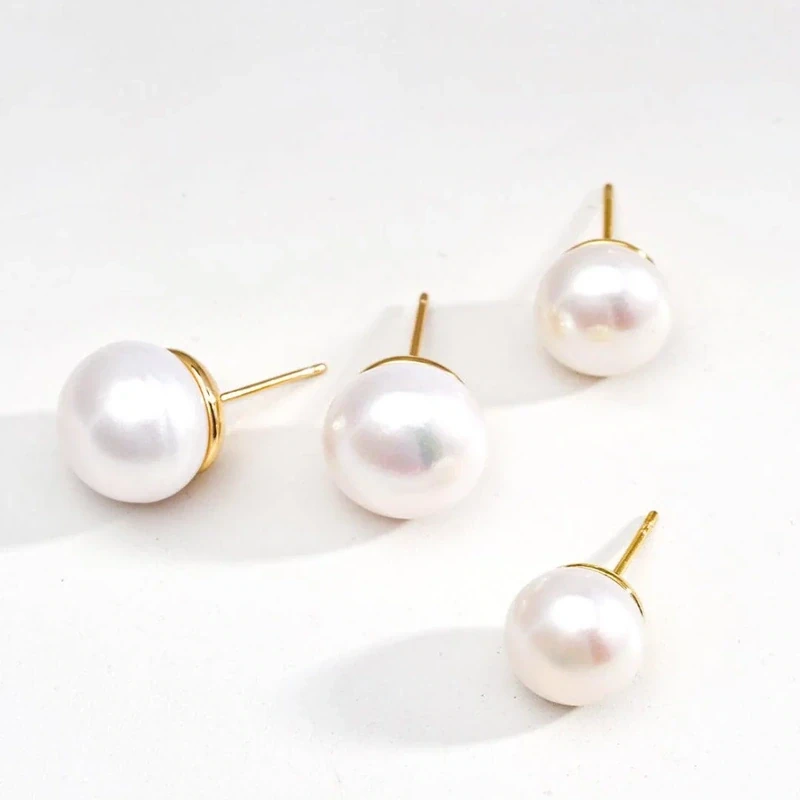
Start by identifying exactly what each measurement describes. Millimeters may refer to pearl diameter, pearl length, or the complete earring, and those values are not interchangeable. For example, the Oval Freshwater Pearl Stud Earrings list 12.5 mm pearls and earring dimensions of 12.5 mm. In this case, the product description gives the same figure for the pearl and the earring dimensions. That is more informative than seeing a single number without a label.
When descriptions provide a range, treat it as a range rather than a fixed size. The Valeria I Baroque Pearl Studs list pearls at approximately 9–11 mm and an overall length of approximately 15–18 mm. The difference signals that the full earring extends beyond the pearl. Before comparing products, note each value beside its label: pearl size, overall length, and any other stated component measurement. If a dimension is not given, do not estimate it from another measurement or assume that the word “stud” means the pearl itself is the only visible element.
Separate pearl diameter from earring length
Diameter is most useful for imagining the scale of a pearl that sits at the lobe. For a non-round pearl, however, a single diameter can be an incomplete description: length and width may differ, and an irregular outline may not fit a simple circle. The earring’s total length helps explain how far the design reaches vertically, but it does not necessarily tell you how wide the pearl appears. Read the shape and the stated dimensions together rather than treating any one number as a complete picture.
This distinction is especially important when comparing a close-set pearl with a short-drop design. A pearl measuring around 10 mm might be part of an earring whose total length is considerably greater, depending on the stud and attachment. Conversely, a listed overall dimension may be nearly identical to the pearl measurement, as with the 12.5 mm oval pair. If the description gives only one measurement and does not specify its scope, avoid making a precise comparison with a listing that clearly separates pearl size from total length.
Notice how a short drop changes the profile
A short drop adds vertical movement and can make an earring read as longer than a pearl that rests close to the ear. The Valeria I Baroque Pearl Studs are described as a spherical stud with a baroque pearl attached on each side, and their approximate overall length is 15–18 mm. The pearls themselves are approximately 9–11 mm. These measurements help distinguish the pearl’s scale from the longer profile of the complete design. They do not, by themselves, describe how the earring will sit on every wearer.
Think about the silhouette you want when viewing the earring from the front and at a slight angle. A close-set oval can keep attention on the pearl’s outline; a short drop introduces a visible connection and more vertical emphasis. The Valeria I Baroque Pearl Studs also use baroque pearls, whose shapes naturally vary and may include imperfections, so individual pairs differ. That variation can alter the apparent outline without changing the stated size range. If a tidy, matched silhouette is your priority, consider how much shape variation you are comfortable with as well as the measurement.
Choose scale with ear placement in mind
Where an earring sits on your ear affects its visual scale. A pearl positioned at the lobe’s center may appear balanced, while a larger pearl near the lower edge can feel more prominent. A drop places some of the design below the piercing, so its overall length contributes to the look as much as the pearl itself. Consider your usual styling and the space you want the earring to occupy rather than assuming a measurement will look identical on every ear.
A practical comparison is to use the listed measurements as a starting point, then picture the pearl and full earring separately. If you already wear earrings with a known dimension, compare the new pearl’s diameter with that familiar reference and separately compare the total length. This is a visual planning aid, not a guarantee of fit or appearance. Piercing position, lobe shape, and the pearl’s outline can all affect how the design reads. The earrings collection can help you compare different profiles, but check each individual product’s measurements rather than assuming styles within a collection share a scale.
Account for shape, not just the number
A millimeter figure does not capture the whole appearance of a pearl. Oval, teardrop, and baroque shapes distribute their visual weight differently from round forms. An elongated pearl may look more vertical at a given measurement, while an irregular outline can extend in more than one direction. For non-round pearls, read whether the listed figure refers to length or another dimension, and do not interpret an approximate range as a guarantee that every pearl has the same outline.
The ZENOBIA Garnet & Pearl Studs pair a freshwater teardrop pearl measuring 10–12 mm with a 6 mm natural garnet bead and S925 silver. Those details describe two components, not a single pearl diameter or an overall earring length. No total earring dimension is listed, so the pearl measurement should not be used as if it were the full profile. Comparing this design with a 12.5 mm oval pearl requires attention to both form and measurement scope: a teardrop and an oval may create different silhouettes even when their stated sizes are relatively close.
Compare product descriptions consistently
Use a short checklist when reviewing several pairs. First, record the pearl’s stated measurement and whether it is exact or approximate. Second, note whether the product lists an overall earring length. Third, identify the shape and any additional visible component, such as a stud or bead. Finally, check the material options separately from size; a choice of metal does not change what the pearl measurement represents. This method helps keep a product with a short drop from being mistaken for a simple pearl-only stud.
For instance, the oval pair lists a 12.5 mm pearl and a 12.5 mm earring dimension, while the Valeria I lists approximately 9–11 mm pearls and a 15–18 mm overall length. The ZENOBIA description specifies a 10–12 mm teardrop pearl and a 6 mm garnet bead, but not a total length. These descriptions do not offer identical measurement sets. Compare what is actually stated, and leave unknown dimensions unknown. If a particular total length is essential to your decision, look for a listing that provides it rather than deriving it from the pearl size.
Make the final choice by profile
Before choosing, decide whether you want the pearl to sit visually close to the lobe or extend below it. Then set a preferred pearl scale, using the listed millimeter value as a concrete reference, and check the overall length wherever it is provided. Consider shape alongside size: an oval or teardrop can create a more elongated impression, while baroque pearls vary in outline. If you are comparing styles, evaluate each one by the same questions instead of relying on “medium” or “classic” as a size description.
Finally, keep the limits of the listing in view. Measurements communicate dimensions, not weight, how an earring will feel over a full day, or exactly how it will sit on your ear. Do not infer those details when they are not stated. Choose the profile whose pearl size, shape, and documented overall length best match the look you want, and give extra attention to listings that separate pearl measurements from total dimensions. That simple check makes a more informed choice possible without confusing a prominent pearl with a longer earring.