Pearl names can refer to different things. Freshwater identifies a pearl category, while rice, button, and coin describe shapes. Keeping those labels separate makes it easier to understand a product description and select jewelry for its silhouette rather than assuming a shape tells you where a pearl came from.
These three profiles offer different visual effects: rice pearls tend to look elongated, button pearls flatter and rounded, and coin pearls broad and flattened. The words are useful guides, not promises that every pearl in a piece will be identical. Shape variation is especially relevant when pearls are described as baroque, a term for irregular shape rather than a pearl category or proof of origin.
Shape names describe silhouette, not origin
A pearl's shape label answers a different question from its category. Freshwater is one pearl category; Akoya, South Sea, and Tahitian are other categories. Rice, button, coin, and baroque describe forms. A shape name by itself therefore does not establish whether a pearl is freshwater, another category, cultured, or natural. For example, the phrase “rice pearl” is not enough to identify the pearl's origin or how it formed.
The Gemological Institute of America distinguishes natural pearls, which form without human intervention, from cultured pearls, which grow with human intervention and care. Cultured pearls are real pearls. When shopping, read the whole material description for an explicit category and origin statement instead of deriving one from a shape word. GIA's pearl description offers background on these distinctions. This is a more dependable way to interpret terminology than treating familiar jewelry labels as interchangeable.
Rice pearls: an elongated, narrow impression
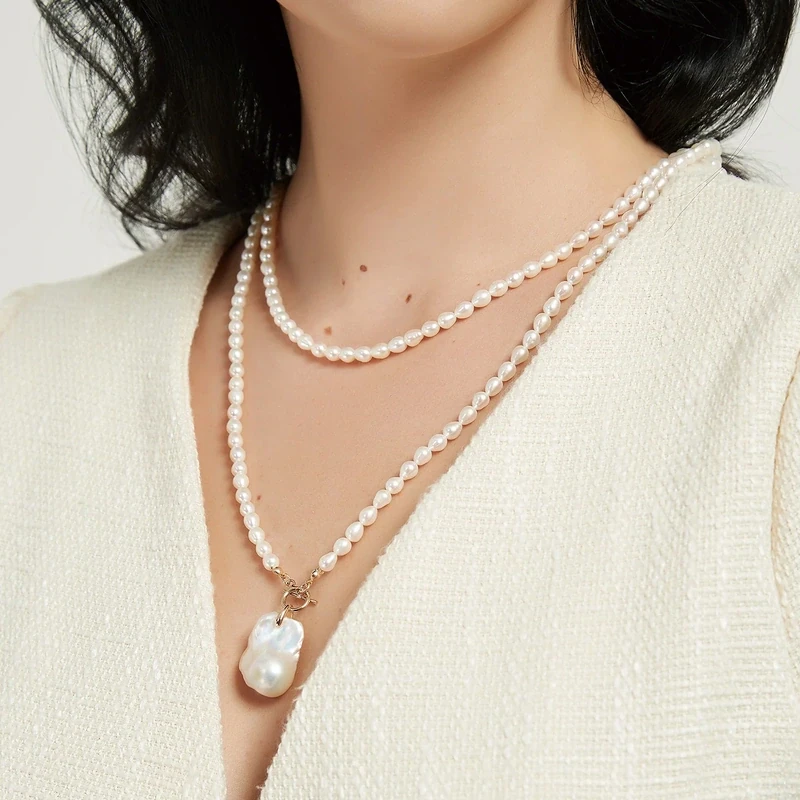
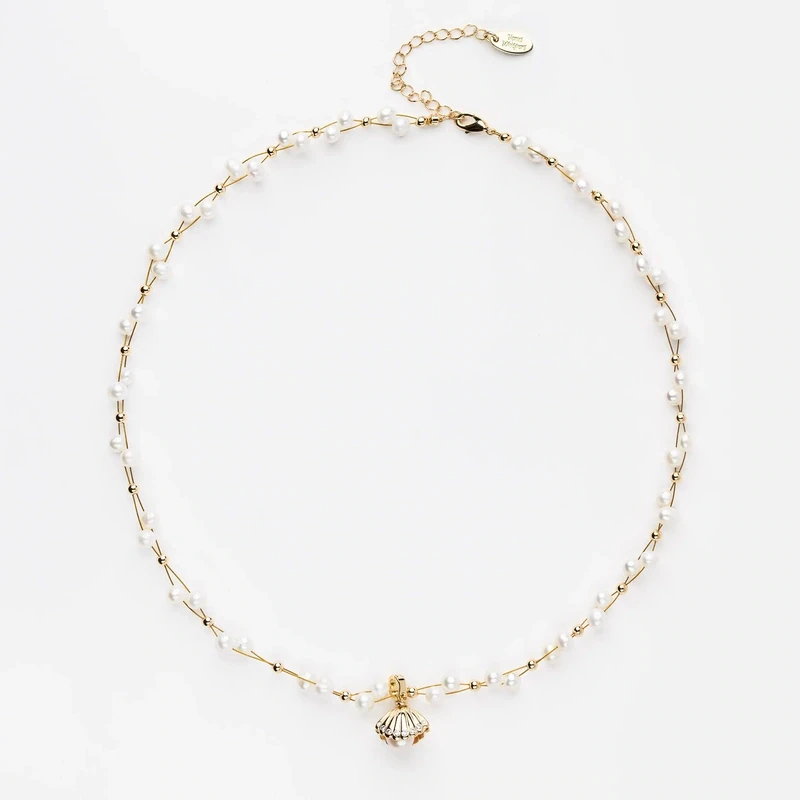
Rice is a practical visual description for an elongated pearl profile, often narrower than it is long. In a strand, repeated rice shapes can create a directional rhythm: the eye follows the pearls along the line rather than reading them as a row of broad, round forms. This can make a necklace feel delicate or textured, depending on pearl size, spacing, and the other elements in the design. The label does not guarantee that each pearl has precisely the same length or outline.
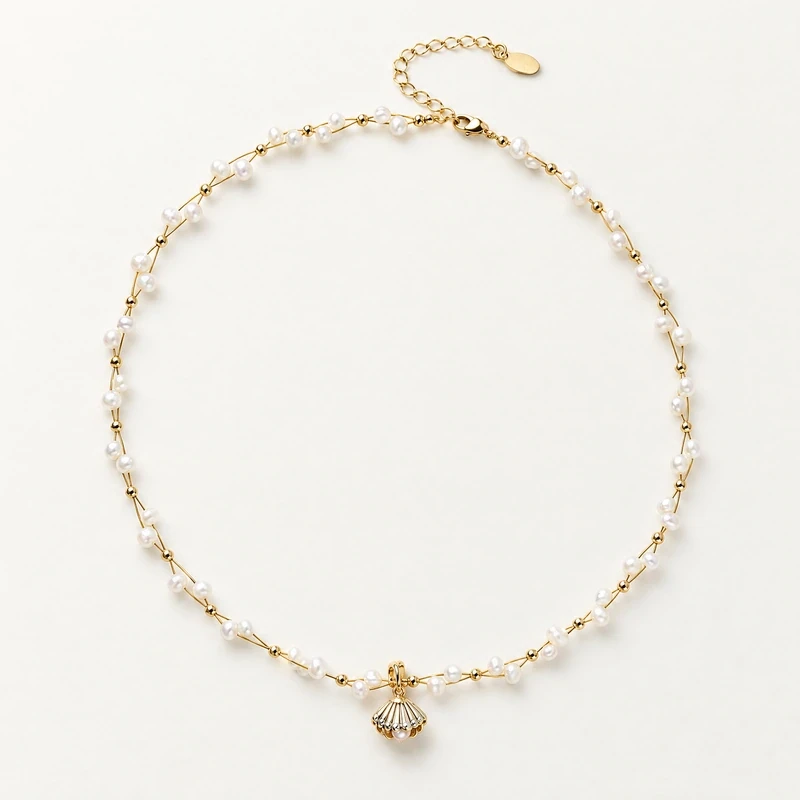
The Rice Pearl Necklace, Ref. 070 is described as using freshwater baroque rice pearls strung along a sleek wire, with a sculpted seashell charm. Its listing names 14K gold-plated metal and gemstone details as materials. This example shows how shape can be part of a broader design: the elongated pearls establish a line, while the charm provides a focal detail. It does not make the rice label a statement about pearl origin beyond the product's explicit freshwater description.
Button pearls: a flatter rounded profile
Button pearls are generally understood by their flattened, rounded appearance. Compared with an elongated rice silhouette, a button profile can read as compact and softly domed. In earrings or settings, that broader face may sit visually like a small focal disc, though the exact outline and depth can vary. The name is a shape cue, not a promise of a perfect circle, identical dimensions, or a particular pearl category.
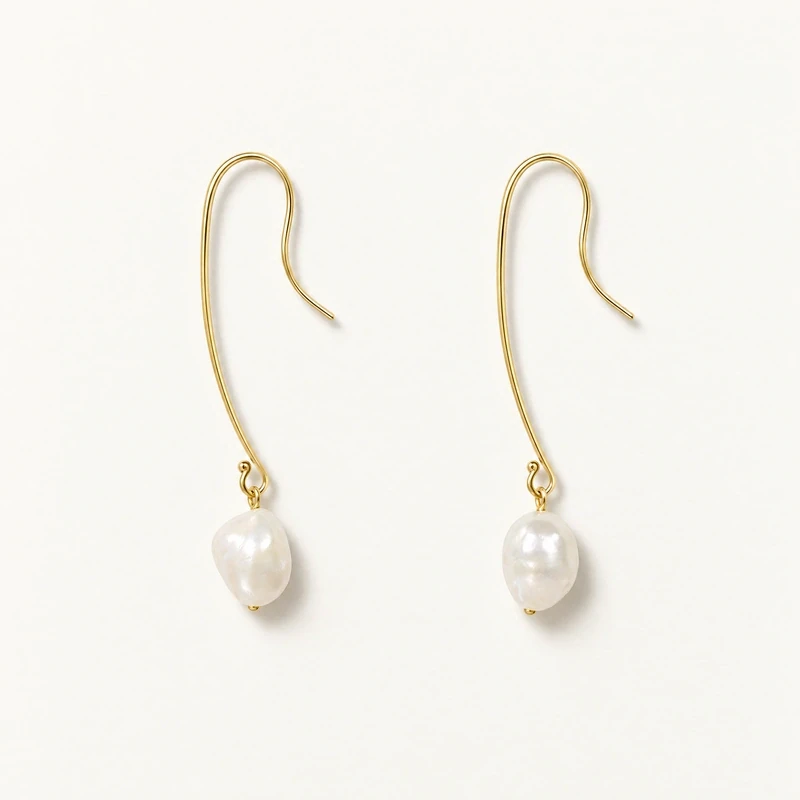
In the 14K Gold-Plated Pearl Earrings 074, the product description identifies freshwater baroque button pearls set within sculptural 14K gold-plated frames and accented with engraved gemstone details. Baroque indicates irregular shape, so “button” and “baroque” can both help describe a pearl: one suggests a flattened profile, while the other signals irregularity. The product description does not specify measurements, so compare the overall pictured or described silhouette rather than assuming a particular pearl size.
Coin pearls: broader and flatter in appearance
Coin is a shape label for a broad, flattened profile. That wider face can make a pearl more visually prominent than a narrower rice shape, even when no exact size is stated. The profile may suit someone who wants the pearl itself to be a noticeable feature, while a flatter form can create a different outline from a rounded or elongated pearl. “Coin” remains a descriptive shape term; it does not identify a freshwater or other category on its own.
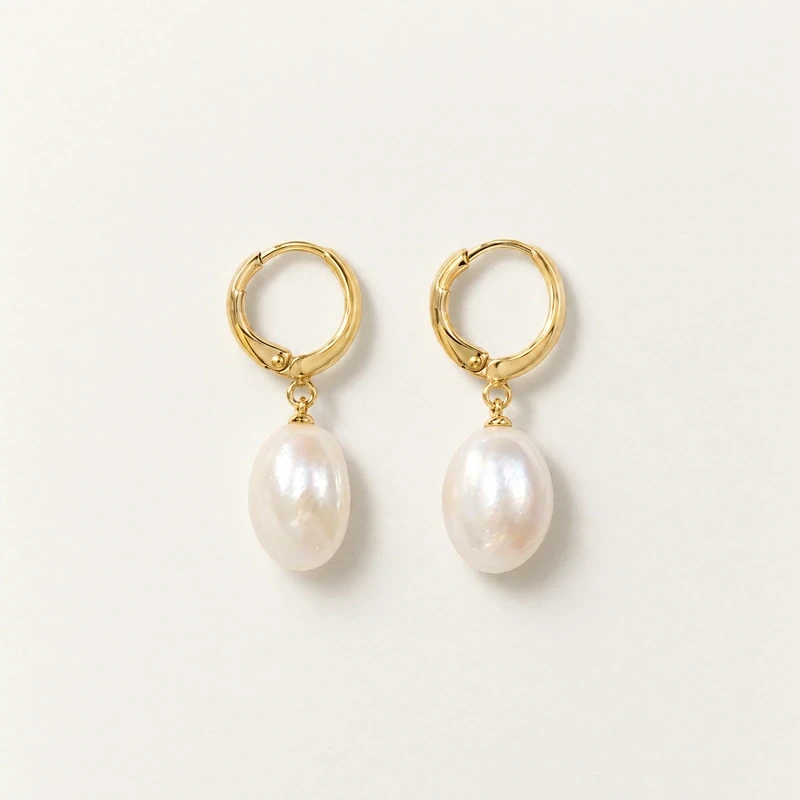
The Irene Freshwater Pearl Earrings provide a useful product-specific comparison. They feature three freshwater pearls on each side, and the listing offers coin-shaped or baroque-shaped pearls. The larger coin-shaped pearls create the longer drop, approximately 7–7.5 cm, with pearls approximately 10–15 mm. The baroque-shaped option has an approximately 5–5.5 cm drop and pearls approximately 8–10 mm. These are the listed measurements for these earrings, not a universal size range for coin or baroque pearls.
Baroque is a separate shape description
Baroque means irregular shape. It does not name a pearl species, establish freshwater origin, or prove that a pearl formed without human intervention. A baroque pearl may also be described with a more specific shape word when the description supports it, as in the button pearls in style 074. Reading both terms together gives a fuller picture: one provides a broad profile cue, and the other warns that the form is not regular.
That distinction matters when comparing pairs and strands. An irregular outline can mean individual pearls differ, and the product description may call attention to that variation. The Irene earrings listing specifically notes that baroque pearls naturally vary in shape and may have imperfections, and that each pair will differ from the pictured earrings. It also describes pearls as hand-picked for strong luster and minimal blemishes. Those details apply to that product description; they should not be generalized to every baroque pearl or treated as a formal grading scale.
Choose a silhouette for the way you wear it
Start by considering the outline you want near the face or along a neckline. Rice pearls can add an elongated, directional texture; button pearls offer a flatter, compact look; coin pearls give a broader face and may become a more prominent visual feature. Think about the jewelry's scale as a whole, including settings, charms, and the number of pearls. The pearl shape is one contributor to the effect, not the only one.
For earrings, compare the full drop measurement as well as the pearl dimensions when both are provided. In the Irene styles, the coin-shaped option has the longer listed drop, while its baroque option is shorter. That is a useful decision point for someone choosing between a longer and more compact earring, without assuming every coin style will hang longer than every baroque style. Browse the broader earrings collection with a preferred silhouette in mind, then check each item's own materials and measurements.
Read product descriptions with precision
When evaluating a listing, separate what it actually states into a few questions: Which pearl category is named? What shape words are used? Are measurements listed? What other materials and design details are listed? This approach avoids turning a familiar shape label into an unsupported claim about origin or construction. If a description says freshwater baroque rice pearls, for instance, freshwater and baroque and rice are distinct pieces of information, not synonyms.
Also keep component materials specific. Ref. 070 lists 14K gold-plated metal, not a solid-gold component; style 074 likewise specifies gold-plated frames. The Irene earrings instead give separate Yellow Gold and Sterling Silver options: the yellow gold option is 14k gold-filled metal, and the silver option is sterling silver. Sterling silver means 92.5 percent silver. Do not treat these materials as interchangeable simply because each can appear in pearl jewelry, and do not assume a fitting or component material beyond what the product listing identifies.
Make the final choice by comparing the whole profile
A practical final check is to compare silhouette, scale, and variation together. If you want a slim, directional impression, begin with rice-shaped designs. If you prefer a flatter rounded focal point, explore button pearls. If a broader, more noticeable face appeals to you, consider coin shapes and check the actual measurements where listed. For irregular styles, allow for variation rather than expecting a perfectly matched outline. The terms guide your search; the product-specific details determine what is actually being offered.
Before choosing, read the complete description and note the named pearl category, listed metal, dimensions, and any statement about variation. For a measured comparison, the Irene earrings give separate drop lengths and pearl dimensions for coin-shaped and baroque-shaped versions. For rice and button examples, the product descriptions identify the design and materials but do not give pearl measurements. Let that difference guide how confidently you compare scale: use numbers when provided, and otherwise choose by the described silhouette without inventing a size or origin.